

The Plight of Algorithm Dependency
What happens when a creator caters to the casual viewer.
Welcome to ‘Close Friends.’ This newsletter series shares a thoughtful piece of content and offers original analysis. Readers also have the chance to share their opinions, and we feature some of them in the newsletter.

Content of the week: The Influencer Cliff
Claims that the influencer bubble has burst have circulated on social media for years. As influencers opted to sell out for money and opportunity, audiences have grown tired of a digital space dominated by commercial content and out-of-touch takes.
This sentiment really accelerated in 2022. The intense lockdowns were over, and many of us were returning to in-person work and schooling. Meanwhile, the online world had changed drastically. The creator economy was significantly different from what it had been before COVID-19, largely thanks to TikTok. The anti-influencer feeling came to a head that very year, particularly after creator Tara Lynn said the photo-sharing app BeReal made her feel as if she were the only person “working” among her friends.
Social media users criticised her comments, noting that BeReal is not an accurate medium to judge someone’s lifestyle or working habits. By this point, Tara’s followers were exhausted from watching influencers flaunt their privilege and lifestyle, seemingly unaware that the average worker is often overworked and underpaid.
Needless to say, this sentiment has held up in 2026... we only need to look to James Charles’ recent scandal as an example.
Over the last week or so, the influencer found himself in controversy after slamming a social media user who slid into his DMs to ask him to contribute to a GoFundMe. The user had recently been laid off from Spirit Airlines and was seeking financial support. While this message may be inappropriate, James responded in a way that could only be described as unhinged.
He posted a video to his TikTok (clearly very angry), calling this user "lazy" and "entitled." James went on to make some uninformed comments about the current job market, which viewers considered insulting. He has since apologised for his initial response, but that video has not landed well either. James is now experiencing his second mass unfollow spree, with the first amid the BYE SISTER scandal.
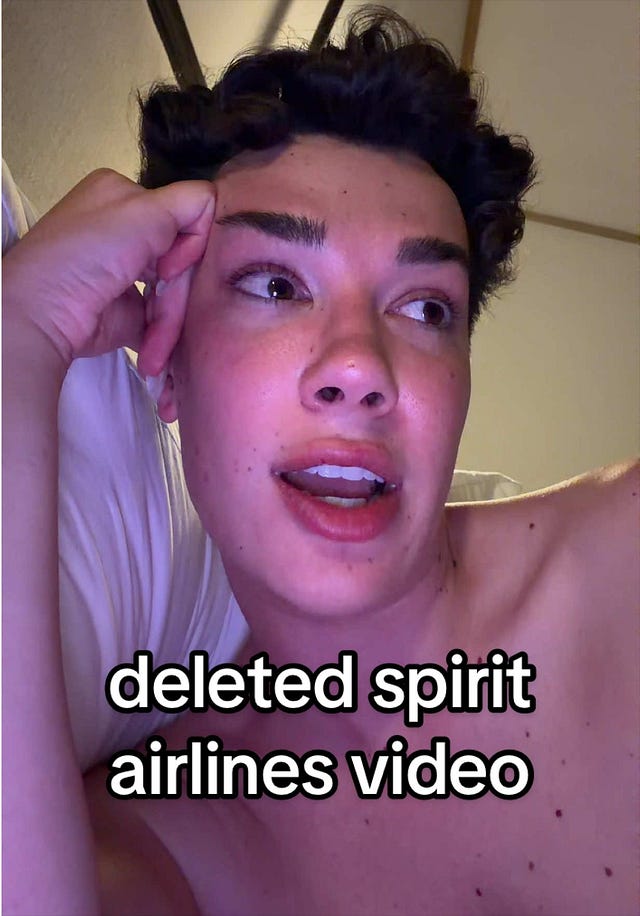
 Tiktok failed to load.
Enable 3rd party cookies or use another browser
Between Tara and James, it’s clear audiences are no longer blinded by a creator’s fame and success. Social media users, especially those on TikTok, are ready and willing to call them out. This shift indicates that the influencer bubble has burst, to some degree.
In a recent TikTok, social media manager @carmscrolls recontextualised this conversation for the 2026 digital landscape. She argued that we are witnessing many creators fall victim to the “Influencer Cliff.” Coined by Carmen, this is when followers or fans are pushed over the proverbial edge and are no longer obsessed with a certain creator.
The cliff stems from the fragility of parasocial relationships and an influencer’s destiny to sell out. The most complicated period, she notes, is when creators move from platform-based success to broader mainstream appeal.
“Influencer growth trajectories leave little room for anything aside from selling out. It is basically a system where you are designed to take the bait and then record the entire dismantling for everyone’s viewing pleasure,” Carmen explains.
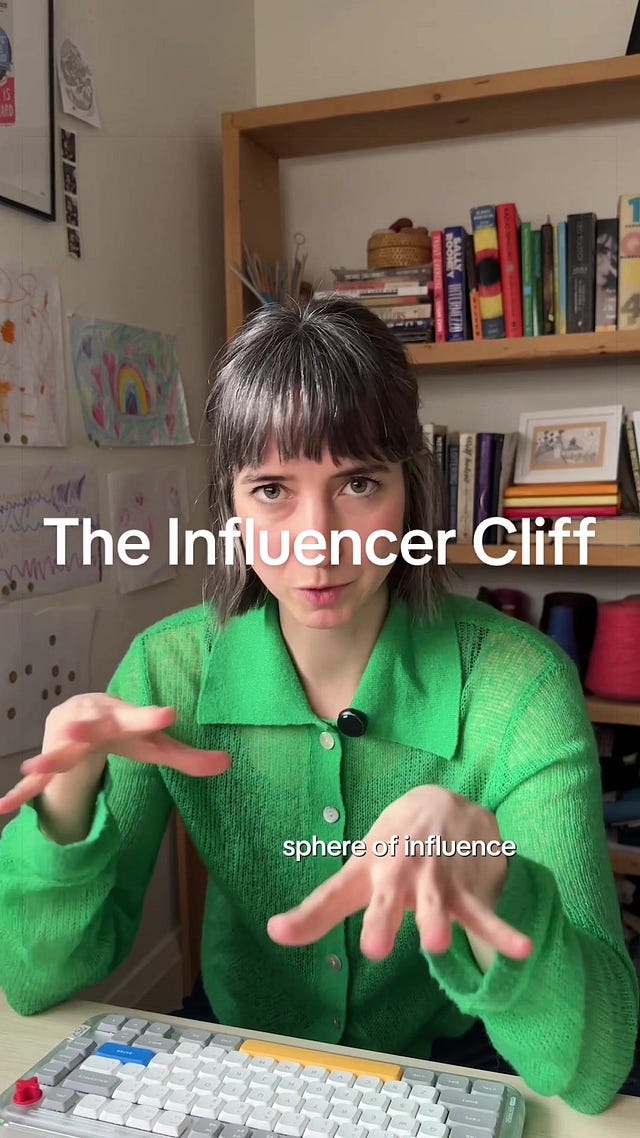 Tiktok failed to load.
Enable 3rd party cookies or use another browser
We have some thoughts, so let’s get into it.
The "Influencer Cliff" is Algorithmic
Emma Chamberlain is the one creator Gen Z has been obsessed with for years.
Emma’s origins and rise on YouTube are pretty well-documented. She pioneered a new editing style, defined by jump cuts, sound effects, and “Editing Emma” cut-ins. In 2019, only two years into her career, The Atlantic labelled Emma the “Most Important YouTuber,” a title that has evolved with her. While she has stepped back from her personal YouTube channel, she remains an “important” cultural figure. That much is clear from her role as the Met Gala’s special digital correspondent every year since 2021.
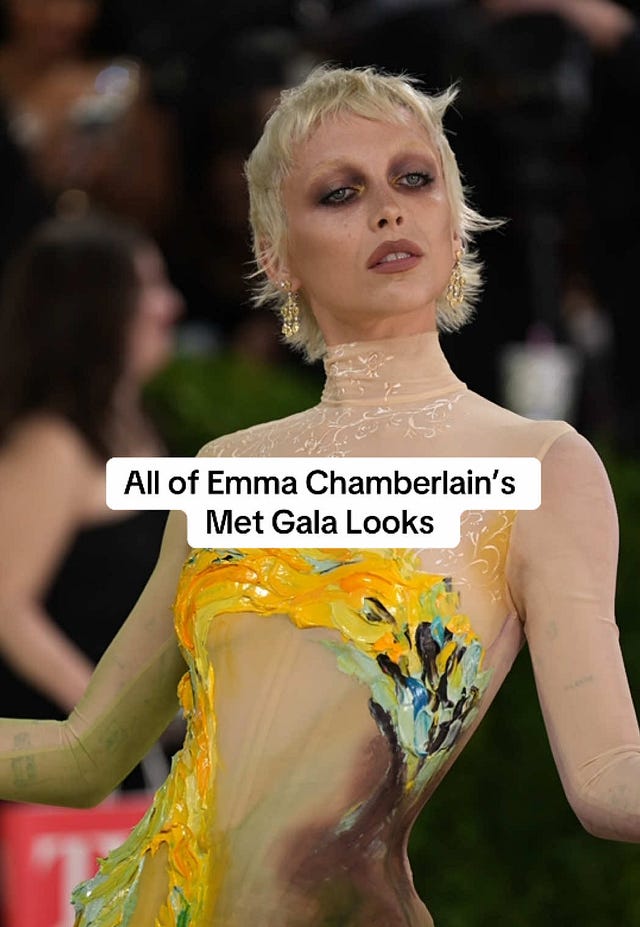 Tiktok failed to load.
Enable 3rd party cookies or use another browser
However, her place in pop culture has changed over the years. Emma’s breakthrough ushered in an era of “relatability” on YouTube, a decisive shift away from the highly produced content that had littered the platform before then. These days, “relatability” has become the buzzword to capture youth audiences... and honestly, it doesn’t really mean much. Brands are feigning authenticity by posting memes, and creators are performing relatability in perfectly curated TikTok vlogs.
On top of this, someone like Emma is no longer relatable. She owns a coffee company, a beautiful home in Los Angeles, and is frequently seated in the front row at designer shows. Her success has come with a caveat: What happens when Emma Chamberlain — the creator who reinvented relatability — is no longer relatable? This is a question that internet culture enthusiasts have been asking for years now, and one that Carmen also picks up on in her TikTok. Carmen specifically mentions Alex Cooper and Matilda Djerf. She argues that these women fell off the cliff after they “ascended from relatable, scrappy to full-on corporate entity with a team.”
But Emma, too, has had moments where her newfound “unrelatability” has angered her fans... pushing her toward the edge of the so-called cliff.
In 2023, TikTok users famously became frustrated with Emma’s podcast, Anything Goes, arguing her commentary lacked nuance. The collective solution was for Emma to enrol in university, with listeners arguing that she would benefit from the academic challenge and direction. The criticism levelled against the podcaster may have been valid, but it was also a pretty nasty pile-on of a then-22-year-old.
Emma continued podcasting until April 2026, when she announced she would be taking an indefinite hiatus from Anything Goes to focus on other endeavours.
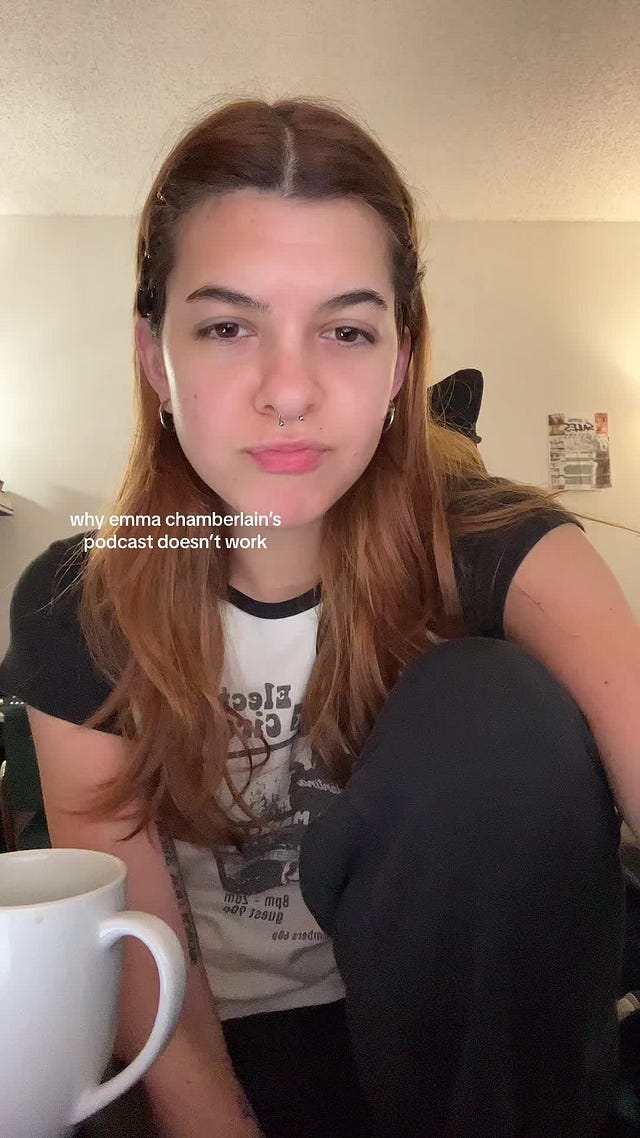 Tiktok failed to load.
Enable 3rd party cookies or use another browser
Though Emma has moments where she loses touch with her audience, she is (admittedly) a bit of an anomaly. She has managed to parlay her YouTube fame into a fully-fledged career and it-girl status — and unlike most creators who make that transition, she has retained a devoted Gen Z fanbase throughout.
But if someone as beloved as Emma can get close to the “Influencer Cliff,” no influencer is safe. The threat runs deeper than any individual’s choices.
In her TikTok, Carmen notes two causal factors that may lead to the cliff: the fragility of parasocial relationships and an influencer’s tendency to sell out for financial gain. However, there is also a structural aspect at play here: the recommendation-driven algorithm.
The advent of these algorithms (Think: TikTok’s FYP or YouTube’s Recommendation System) has moved us away from a social-first feed. OG Instagram and Twitter content was delivered to users in chronological order, without infinite scroll; we consumed content from friends and family, as well as from celebrities we chose to follow. Today, that couldn’t be further from the truth. We are fed content by strangers, often with little to no context about who they are or what they do.
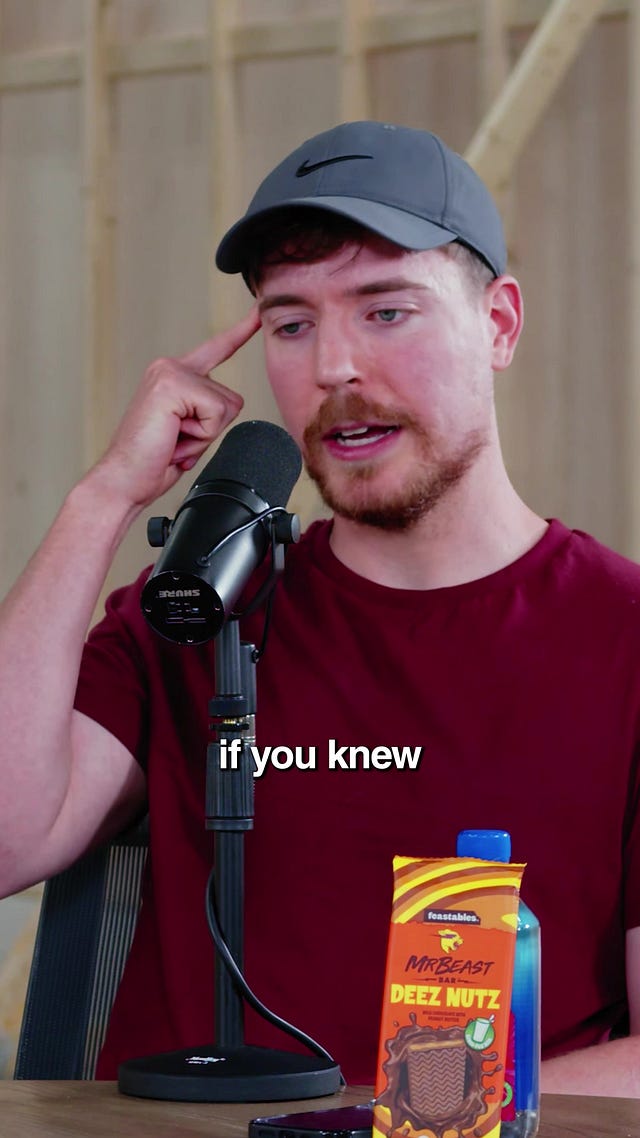
These algorithms, while different across platforms, reward content that captures attention. The most subscribed-to YouTube channel, MrBeast, is a product of this system. His content is high-stakes, fast-paced and extravagant — what The Washington Post described as “retention editing” in 2024.
It’s worth noting that the “Influencer Cliff,” as Carmen frames it, is disproportionately experienced by women. Male creators, like MrBeast, who “sell out” for attention and retention, rarely face the same level of audience backlash (and on MrBeast, specifically, his largely younger audience holds him to different standards entirely).
 Tiktok failed to load.
Enable 3rd party cookies or use another browser
But no matter how the audience feels about sensationalised, attention-seeking content, the algorithm rewards it.
In her recent interview on the Call Her Daddy podcast, Tana Mongeau reflected on how this dynamic shaped her career trajectory. Between her short-lived music era, posting melodramatic storytimes, and marrying Jake Paul, she described a pattern of escalating her content for attention. Even when she took it too far, she kept posting because the algorithm rewarded her.
“It all comes back to the story times, right? Like, I’m using these salacious titles and these crazy things, and I’m learning that people want to see this. I’m blurring those lines, and I’m literally praying that an Uber driver gives me a bad experience so that I can pay my bills, get away from my parents, and hopefully get emancipated. It all started there, and then it just snowballed,” she tells Alex Cooper.
Tana’s experience indicates how complicated it can be to post online when these algorithms dominate content consumption. Algorithm-driven recommendations have democratised discoverability entirely. It has made content creation an option for people posting online from their childhood bedrooms, like Tana did. But, in practice, these creators are forced to “sell out” for virality and reach.
This dynamic is a significant departure from the community-based approach of chronological feeds. When your followers were the primary people seeing your content, catering to them was simply a good strategy. Growth was undeniably still a factor (and selling out existed long before TikTok), but the incentive structure was different. The sense of accountability to the audience was more intense because it was objectively harder to grow, and audiences were guaranteed to see the creators they followed. Meanwhile, in today’s digital landscape, a video can reach millions of strangers before a creator’s own subscribers ever see it. Now, the incentive is to perform for casual viewers rather than catering to loyal ones.
This promise of exponential growth may seem worthwhile, but arguably it shortens the distance to the “Influencer Cliff.”
Citing polling by influencer Jessi Jean, Carmen notes that the main reason audiences turn their backs on creators is when their entire feeds feel like a commercial. Take Dixie D’Amelio as an example (who we have also discussed before here). Once considered TikTok’s cool girl, she now almost exclusively posts sponsored content. Her last two TikTok videos were ads for APM Monaco for Coachella.
Dixie’s commercial content receives far less engagement and praise than her regular TikTok content. Her most recent video has accumulated 3.2 million views, with 28k likes. Comparably, a 2024 video with a similar number of views (3.5M) showing Dixie lip-syncing in the mirror has almost triple the number of likes.1 On top of this, the comment section of her recent post is flooded with users asking why she only posts sponsored content these days.
Through Dixie, we can see how commercial content is an issue for the creator-audience dynamic... but so is building a following in an environment that caters to casual viewers. This segment of the audience is (arguably) less likely to give creators the benefit of the doubt when it comes to sponsored content. We see this at Centennial World. Our returning viewers welcome branded campaigns because they understand how important these deals are to our content output as an independent media brand.
That said, embracing casual viewership rather than a community-driven content strategy shortens the distance to the “Influencer Cliff.” These viewers have minimal investment in a creator’s career, content, or growth... and ironically, the algorithm ensures that they are the ones who see it.
The platforms these creators depend on are built by big tech companies, which define the metrics by which success is measured. Those metrics are not about follower loyalty, they are engagement, reach and growth. Platforms profit when creators chase virality, because more content and more posting mean more users, more time on-site and more advertising revenue.
Therefore, the influencer cliff is not just the result of a creator losing touch or selling out. It is the result of a structure that relentlessly rewards growth at the expense of the content and characteristics that made those creators worth following in the first place.
The audience weighs in
We shared the TikTok with our audience and here’s what some of you had to say.
One podcast listener reached out via direct message, also pointing to James Charles as the perfect example of the “Influencer Cliff” in action.
“When I think of the influencer cliff I think of James Charles. It is so crazy that people KEEP coming back. It really just is a coping mechanism at this point from his fans. They’re holding out hope that the person they originally fell in love with is still in there somewhere. I think this is what the TikTok is getting at.”
Meanwhile, listener Madison offered an interesting outside perspective — noting that the "Influencer Cliff" feels most prolific on TikTok, even as someone who doesn't frequently use the platform.
“I’ve always felt like the parasocial relationships on that app [TikTok] felt much more tenuous than on platforms like YouTube. I think back to in-person events transitioning to feature more TikTok creators and not having the attendance expected. To me, this makes sense because TikTok [is not] creator-focused, but as I said, I don’t actively use the app!”
Other interesting bits
Breaking down some other content we found interesting, whether that be headlines, commentary about internet culture and the creator economy. Here’s what is happening online:
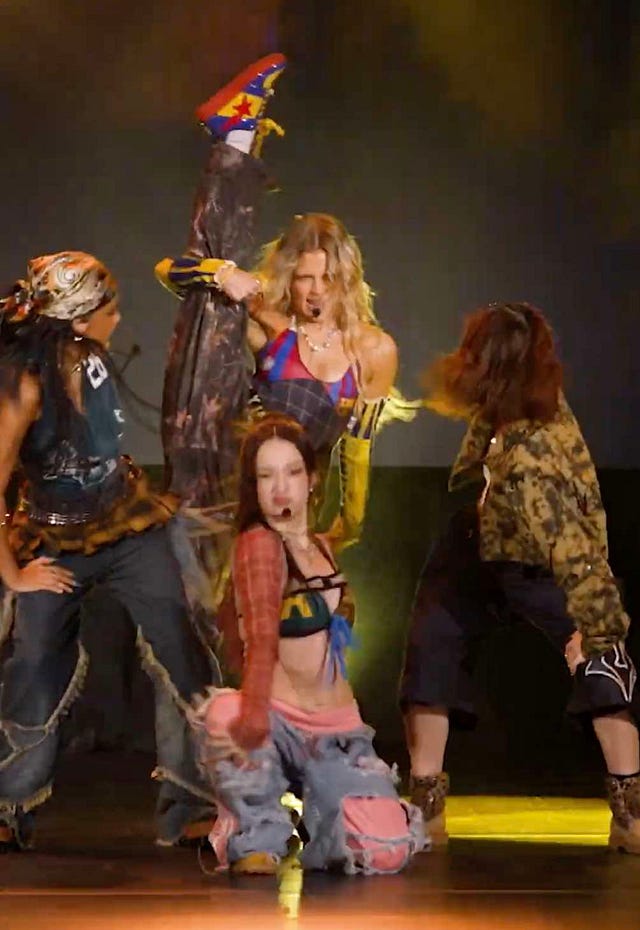
HYBE x Geffen is at it again. The joint venture unveiled its latest global girl group: SAINT SATINE. Three members — Emily, Samara and Lexie — came from Dream Academy and competed to be part of KATSEYE. The fourth member, Sakura, was announced as the "Final Piece" after competing in a survival show to join the group. TikTok users are not happy with the decision, pointing out that Sakura is a minor alongside members who are all in their early 20s, an age gap that has sparked questions about the ethics of K-pop girl groups and training methods.
 Tiktok failed to load.
Enable 3rd party cookies or use another browserHow a Celebrity Ambassadors Still Relevant? In our most recent deep dive episode for the infinite scroll podcast, we explore the perceived value of celebrity endorsements, how brands have had to adapt this strategy to the social media era, and attempt to answer the question: does Gen Z even respond to celebrity endorsements? Or is this marketing strategy better left in the past?
Meg Stalter and Vanillamace are an iconic duo. The comedian and actress is officially in her pop star era, having released her debut single ‘Prettiest Girl In America.’ Last week, she tapped the streamer for a remix, with Vanillamace hopping on the track.
Why are all the cool girls making That Face? In a new video essay, Mina Le explores the implications of the Gen Z pout. Throughout the video, she discusses photographic conventions of previous eras and even examines whether the Gen Z pout is a form of micro feminism.
Gen Z don’t want to be influencers anymore. According to a new Yahoo/YouGov poll, only 5% of Gen Z want to be digital creators or influencers — this is a stark contrast from 2023, when a Morning Consult poll found that more than half of the demographic wanted to be influencers. Interestingly, 18% of respondents said they would like to model their adult life after a "tech entrepreneur who isn't famous."
That appetite for entrepreneurship tracks with a broader trend. According to new research from LinkedIn, two thirds of Gen Z (66%) and Millennials (68%) in Australia believe entrepreneurship is more achievable today than it was for previous generations. Technology is a key factor here: almost two thirds of entrepreneurs (62%) say AI and digital tools are critical to starting or running a business, and more than half (56%) say access to those tools has made it easier to get started.
How the world became a casino. In a recent episode of the 404 Media Podcast, Emanuel Maiberg discusses the logic behind prediction markets (like Polymarket, Kalshi and other sports betting apps) with guest Natasha Dow Schüll.
Feel free to share your thoughts about today’s newsletter, or send through any content you want us to cover in the future.
It’s worth noting that engagement drop-offs are rarely caused by a single factor. Dixie’s numbers may also reflect broader audience fatigue, reduced posting frequency or shifts in how TikTok’s algorithm distributes her content. Though, notably, many users have left comments criticising her for commercial content, specifically.